Newsletters

In The Loop Secondary Edition

{item_alt_tag}

ISSUE 58

Share your feedback on Bikeability Level 2 & 3 


The Bikeability Trust is gathering feedback from secondary schools that received Level 2 or Level 3 Bikeability training this year. We want to better understand your experience so we can improve how we engage and support schools in delivering Bikeability in future.

Whether the training brought clear benefits or you encountered practical challenges, your views will directly influence how Bikeability develops its school engagement approach and the support offered to pupils, teachers, and delivery partners.

The survey takes no more than 10 minutes, and as a thank you for taking part you’ll have the chance to be entered into a prize draw to win one of five £50 Amazon vouchers.

All responses are confidential and anonymous. The survey is being conducted by Caledonia Market Research on behalf of The Bikeability Trust.

Deadline: midnight on Sunday 8th March

COMPLETE SURVEY HERE

Your feedback will make a real difference — we’d greatly appreciate your time.

Free Teacher Cricket CPD - School and Teacher Sign Up Info 

Please see below all the information you will need to sign both your school and teachers up to the training which will then ensure you will receive the free kit (worth around £400 and includes stumps, carbon fibre bats, balls and cones). There are a couple of forms to complete, but hopefully worth it for free training and kit.

All schools who have a teacher attending the training will need to sign up (as well as the individual teachers). This only needs to be done once and ideally by the Head of PE. To sign your school up please click the link below.

School Sign Up Link

Following sign up we will send a form to you to find out what cricket takes place in your school currently so that we can understand the impact the programme has.

Date

Time

Venue

To Book

Wednesday 4th March

3:30-5:30pm

The Kings School, Ottery St Mary, EX11 1RA

CLICK HERE

Monday 9th March

1:30-3:30pm

Paignton Academy, TQ4 7DH

 CLICK HERE

Wednesday 11th March

 2:30-5pm

Devonport High School for Girls

CLICK HERE

 Monday 16th March

 3:30-5:30pm

Pilton Community College, EX31 1RB

CLICK HERE

Monday 23rd March

3:15-5:15pm

St Peters School, Exeter, EX2 5AP

CLICK HERE

Tuesday 31st March

3-5pm

Stoke Damerel Community College, PL3 4BD

CLICK HERE

Enhancing the PE Experience for Muslim Girls

For many students, the school environment is their first entry point into sport.

However, currently only 40% of Muslim girls say they feel comfortable participating in physical activity.

That's why, in partnership with Nike, Youth Sport Trust and Muslim Sports Foundation, we have developed a suite of online resources that offer simple, actionable steps to help teachers and coaches build more inclusive environments for Muslim Girls.

Free Resources for Educators 👇

• Educational Toolkit: Designed for use within school settings.

• Online e-learning Training Module: To support staff professional development.

• Top Tips Guide: Practical advice on kit, scheduling, and delivery.

GFIS Muslim Girls Toolkit by Marked... - Flipsnack

Track and Field Cup

The Track and Field Cup 1st Round will be held at Braunton on Tuesday 5th May

Entry form

https://esaa.org.uk/product/track-field-cup-2026/

Deadline for entries  6 pm on Friday 6th March - more info below

https://esaa.org.uk/competitions/track-field-cup/

The Regional B final will be held at Exeter on Tuesday June 16th

The Regional A Final will be held at Millfield on Wednesday June 17th tbc?

How Chaos Agents Build Transferable Skills 

In Physical Education, we often spend so much time trying to make games "fair" and "balanced" that we accidentally strip away the opportunity for students to practice the messy interpersonal skills required in the real world. By introducing a “Chaos Agent”, you are introducing intentional friction to force the other students to navigate unfairness, ambiguity and sudden shifts in power.

The learning doesn't happen during the chaos, it happens during the reflection after the chaos. Here is how it targets those "soft" skills:

  • Resilience: Students learn to maintain performance and emotional control when the "rules" suddenly disadvantage them. It moves them from "That’s not fair!" to "Okay, how do we handle this?" 
  • Conflict Resolution: When a Chaos Agent makes a controversial call or changes a rule mid-play, the group must decide how to address it without the teacher intervening. 
  • Negotiation: If a Chaos Agent has the power to "veto" a goal, the team might have to negotiate with them or change their strategy to make the goal "undeniable."
  • Adaptability: It forces a shift from a fixed game plan to a dynamic one.

Real-World Examples of Chaos Agents

A Chaos Agent is usually a student (or a small group) with a specific brief to intervene in the flow of the game.

Role Name

The "Chaos" Instruction

Skill Targeted

The Rogue Ref

Can change a decision at any time, even if it's clearly wrong.

Emotional regulation and respectful advocacy.

The Mercenary

Can switch teams whenever they hear a specific whistle or keyword.

Rapid re-communication and tactical adjustment.

The Saboteur

Secretly told to "lose" for their team or play poorly.

Identifying internal team issues and leadership/encouragement regardless of the score.

The Rule-Maker

Every 2 minutes, they can add one "illegal" constraint (e.g., "No running for 30 seconds").

Creative problem solving under pressure.

"Super Power" Examples for Invasion Games

While Chaos Agents focus on social friction, "Super Powers" focus on mechanic shifts. These are great for highlighting specific tactical concepts.

1. The Time Weaver (Freeze/Slow Mo)

  • Power: Can shout "FREEZE" once per game. Everyone stops for 10 seconds except the Weaver’s team, who can reposition (but not touch the ball).
  • Learning: Teaches off-the-ball movement and spatial awareness.

2. The Ghost (Invisibility)

  • Power: This player cannot be tagged or tackled. They can move anywhere, but they cannot score.
  • Learning: Teaches teams how to use a "decoy" to pull defenders out of position.

3. The Multiplier (Double Points)

  • Power: Any goal involving this player (as the passer or scorer) is worth double.
  • Learning: Encourages the team to protect a "High-Value Asset" and forces the defense to prioritize specific marks.

4. The Architect (Boundary Shift)

  • Power: Can move the goalposts or change the shape of the "scoring zone" mid-game.
  • Learning: Forces the team to recognise how geometry and spacing affect scoring opportunities.

The Secret Sauce: The "Tactical Timeout"

To make this work for transferable skills, you should use the "Freeze-Reflect-Restart" method.

If you see a team getting frustrated by a Chaos Agent, blow the whistle and ask:

  1. "What just happened to your plan?"
  2. "How did the communication in the group change the moment the 'Rogue Ref' made that bad call?"
  3. "What is one way we can negotiate a better outcome in the next 5 minutes?"

Pro-Tip: Don't tell the whole class who the Chaos Agent is. Tell the Agent their role in secret. This forces the group to diagnose the problem before they can solve it.
Leading Schools in the UK Recognised for Commitment to Pupil Wellbeing 

The Youth Sport Trust has awarded the first Well School accreditations, marking a significant shift in how school effectiveness can be recognised and evaluated in the UK. The new framework enables leaders to evidence wellbeing as a strategic priority through external validation, rather than treating it as a supportive but largely unmeasured aspect of school culture.

The Well School accreditation provides a structured framework allowing schools to evaluate and evidence wellbeing practice with the same rigour applied to academic outcomes and safeguarding provision. The framework aims to be straightforward and realistic to implement within existing structures, without adding extra workload. Through external peer review and a clear rating system, the accreditation supports leaders to demonstrate impact to parents and governors, track progress and embed accountability for wellbeing across whole-school strategy.

In the first 3 months since its launch, over 40 schools have applied for their Well Schools Accreditation, with six schools and a four-school multi-academy trust already peer reviewed and awarded.

Moving wellbeing from intention to sustained action

The fore core areas for measurement in the Well School Accreditation are:

  • Well Culture: Culture of belonging with health and wellbeing at the heart of the school.
  • Lead Well: Staff and pupils are empowered to shape and lead their school’s wellbeing approach
  • Move Well: Every pupil is physically and mentally prepared for learning and life
  • Live Well: Every pupil has opportunities and skills to thrive in school and beyond

Find out more about the Well School movement and accreditation here. 

26 Feb 2026
Y5 & Y6 Indoor Athletics Final Results 2026
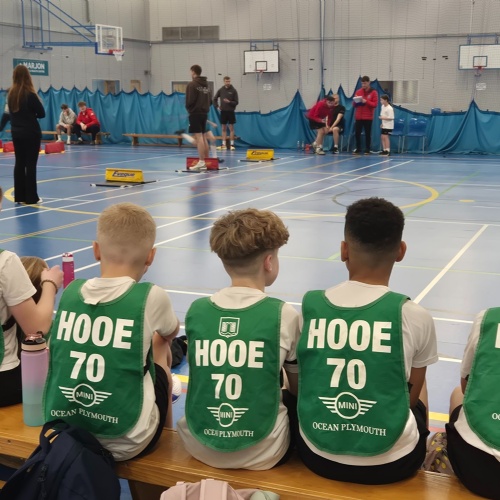
Tuesday 24th February – We held the Y5/6 Indoor Athletics Finals at Marjons. Six primary schools out of 8 were able to attend and, WOW, there were some very close races. Well done to all the children who took part, we hope everyone had a great time. 
Read more
Primary Inclusion Football
10:30am – 12:30pm
04
March